Showing posts with label loveforfilms. Show all posts

Friday, 10 October 2014

Four brand-new Gems now out in Cinemas

This is the thing with blogs, sometimes there are factors influencing the publication of new posts, sometimes there is just life in between.
My third year has started and I'm very excited for everything that is going to come: my dissertation project, the possibility of attending the summer school in NYU, and the exciting opportunity of applying to the London Film School for a MA in Screenwriting.
To celebrate this great beginning and the hopefully bright future ahead I want to share 4 experiences I had at the cinema during the past 3 weeks.

 Boyhood 
(Richard Linklater, 2014)


The splendor of simplicity.
Boyhood was an absolute revelation, a film that I would define splendid for its touching lightness, its great soundtrack and acting and the ambitious, but perfectly accomplished project it achieved.
Cinema has always been interested with the capturing of time-passing and life on screen, Boyhood follows the life of Mason by following his actor and the whole cast over 12 years. This growth process is accompanied by all the changes in technologies, music trends, clothes, dreams and family problems we, kids born in the 90s, went through.
The film is funny, true to itself and deeply moving. A little gem that should be cherished for as long as possible.
My favourite scenes were probably the ones involving the father and his music lectures while driving somewhere, an experience I can absolutely relate to and still one of my favourite moments in the company of my dad.

Watch the trailer here:

20.000 Days on Earth 
(Iain Forsyth and Jane Pollard, 2014)


Thanks for this little history Nick.
Nick Cave, the importance of remembering, the transforming power of performance. These are the three key elements of the exquisite experimental picture following the 20.000th day on earth in the life of living music legend Nick Cave. Being a big fan of his work was only a part of the process of falling in love with this film. The biggest achievement of the film was the intertwining of different spaces and times sequences which exquisitely came from the memory process Nick goes through during the meeting with his psychiatrist. Moreover, photographs, footage of concerts, and stories from Nick's collaborators were used to create this storytelling web that finally forms Nick Cave's memory as a man, a musician, a singer, a composer, a writer, a storyteller. And a damn fine one.
An absolutely dazzling experience, beautifully shot and edited, moving and deep as Brighton's sea.

For you know the time is nigh
When I must remove your wings
And you, you must try to fly.

(The Ship Song, Nick Cave)


Thanks for making us fly Nick.
If anybody is interested Nick Cave will be playing in London in May, I already got my ticket for May 3rd at the Royal Albert Hall. It's gonna be worth every minute of it.

Watch the trailer here:

Gone Girl 
(David Fincher, 2014)


Wow. What the hell just happened? This was my thought during the whole film, but I adored its cleverness and I will soon venture into reading the book. I was completely taken into the story and I never felt the narrative was becoming cliché or the film too long for the narrative. It was amazing to watch it at the Odeon during its big weekend opening because it was a collective spectatorial experience. We all laughed (a lot), got shocked (even more), thought wtf (more than anything) and I thought it was brilliant. The acting was one of its most accomplished components: Rosamund Pyke was unbelievable, stunning, she held the story together and developed her complex character in a very intriguing way. Ben Affleck gave a good performance as well, but, in my opinion, the secondary characters made the film: Neil Patrick Harris as Deni Collings, Carrie Coon as Margo Dunne, Kim Dickens as Detective Rhonda Boney and all the others.
David Fincher and Gillian Flynn created a strong collaboration and managed to turn a best-selling thriller from words to visual without disappointing the readers and spectators.
You will like the film if you're a Hithcock's fan (think about Vertigo, especially), if you liked but also had problems with Fatal Attraction, and if you would love the idea of a combination of these two with much much more.

Watch the trailer here:

Björk: Biophilia Live 
(Nick Fenton and Peter Strickland, 2014)


I happily managed to get a ticket for the Sonic Gala hosted by this year's London Film Festival showing the premiere of Björk's concert focused on her album Biophilia (2011). In my opinion, Björk is one of the most complete visual and musical artists we have today, she creates a whole universe out of her music and she has strong performance qualities through which she can engage, move, electrify and absolutely puzzle her audience. Biophilia as a concept gave life to an album rich in poetry, creativity and dedication. The Earth, the Moon and everything that composes nature around us become the protagonist of the visual design of the concert and the film. They open up to us through the stunning sound and musical instruments expressly created for the album and Björk's voice and gestures accompanied by the stunning female choir from Iceland.
At the end of it I just wanted to stand up, dance and congratulate the directors and producer, and her who has always remained true to her music and herself.

Watch the trailer here:

Friday, 31 January 2014

Suggested Viewings KCL Film Studies

From the module Film Theory I

 
Coeur Fidele (Jean Epstein, 1923) and Smiling Madame Beudet (Germaine Dulac, 1923)

What I liked about those films is their relationship to the Impressionist film theory and movement, I'm becoming more and more fascinated with these early scholarly writings because they make us understand how much we now take for granted in the cinema experience. Germaine Dulac and Jean Epstein were exploring the possibility cinema has of exploring the flux of the human consciousness. If you are interested in the topic these films together with the two authors/directors' main writings are key starting points. You will realize how important a close-up (so common and natural nowadays) was to express that possibility, and the status of cinema as the new art.

From the module French New Wave


The 400 Blows (Francois Truffaut, 1959)

Where shall I start? This film, together with Citizen Kane and Casablanca was one of my first and most beloved approaches to the magic of cinema. Truffaut's autobiographical film is not as much an open eye on his life, but the story of a universal situation regarding growing up and being a teenager in a family and society who are not able to understand you. But this is not everything the film is, this film has not influenced the world for its narrative only. Truffaut was able to find his voice in a new poetic of visual, which, more than anything else, hommages the love for cinema as the medium able to, why not, bring out an individual's hidden self, the medium able to speak directly to the soul. Truffaut's career and life will unfortunately conclude in 1984 after one last film: Confidentially Yours (Vivement Dimanche), the ending sequence of this film is a beautiful conclusion to what he started in 1959, watch it to see what I mean, I'll just tell you that the cinema is the game the children live and play with, the cinema is life.

From the module Topics in World Cinema


The Hour of the Furnaces (Octavio Getino and Fernando Solanas, 1968)

We watched the first part of this political manifesto film divided into three parts and coming out at a very particular moment in history: a moment in which all over the world filmmakers and intellectuals were starting to subvert the system at the service of the people. In this context Solanas and Getino wrote the Manifesto Towards a Third Cinema which is still one of the most important writing about cinema. Influenced by Marxist dialectic and based on class struggle the film has a very complex structures. Each part is subdivided into different sections each cross-cutting between intertitles used to deliver the political message, and the most disparate images: newsreels, advertisements, still images about consumerism, white society critique concerning the Unites States especially. The very disturbing slaughter's scene aims to show the unpleasant work behind the making of products and serves as an allegory for the selling of a nation, Argentina in this case. The iconic final shot shows a still of dead Che Guevara's close-up, a scene lasting 2 mins and 40 secs, through its dialectical film form the film requires the people to complete the last stage of class struggle and reach a new synthesis. A must-see for film lovers who appreciate the political engagement cinema offers.

From the module Cinema and Spectatorship


Bush Mama (Haile Gerima, 1979)

Among this list this is probably the most difficult film to find, but if we do, please watch it. It was a different and puzzling experience. The film is set in the black ghetto in LA in the 70s when the white police was violently attacking the black community. This story is not a common story, though we see characters, but we hardly recognize the characters and identify with them, because they embody the story of a social condition more than that of a single person. The recognizable protagonist is Dorothy, a woman and single mother struggling with alcoholism, parenting, marginalization, and the institutions. A touching text which does not leave a lot of space for melodramatic situations, only for the harshness of the truth.

Friday, 24 January 2014

Suggested Viewings KCL Film Studies

From the module Film Theory I


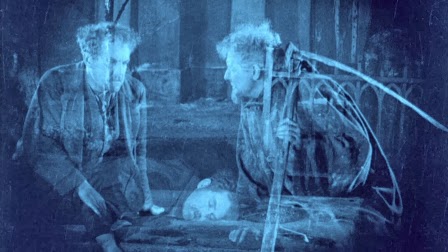
The Phantom Carriage (Victor Sjostrom, 1921)

A early Swedish experimental film playing with film form and the possibility cinema has of accessing different worlds and showing them on screen. A good example to discuss the status of cinema as the Seventh Art, which at the time was still very much debated. The film has a very slow pace, seemingly simulating the lasting of real time and trying to transport it to cinema. The story is loosely based on a Swedish legend similar to A Christmas Carol. The great thing is that you can find it in its entirety on Youtube (I mentioned it last year in a blog post about The Shining and some of its inspirations: http://artbookscinema.blogspot.co.uk/2013/04/seven-months-of-bfi-southbank.html


From the module French New Wave


Et Dieu...créa la femme/And God Created Woman (Roger Vadim, 1956)

If you are interested in stardom, and in female figures especially, this is the film for you. Brigitte Bardot's big debut with the film that changed her star persona both off and on screen. Moreover, the film, with its controversial topics and attitude, opened a debate on the French youth of the Fifties, its problems, indecision, but also its hunger for life. Delightful performance by what would then become the great Jean Louis Trintignant. A controversial picture which would have a big impact on the birth of the New Wave (pay attention to the use of Bardot's body in the opening sequence especially, and spot this shots in a famous Godard's film, Le Mepris/Contempt, to see the use he makes of the female body).

From the module Topics in World Cinema


The Battle of Algiers (Gillo Pontecorvo, 1966)

This week was the time of Gillo Pontecorvo's Golden Lion winning. This film is a stunning example of cinematography accompanied by Ennio Morricone's soundtrack and the use of non-professional actors in the roles of the Algerians. My favourite sequence in the whole film constructs a parallel montage of three different spaces as three Algerian women take bombs to different public spaces in the European part of the city. The sequence is beautifully constructed to build suspense, as we know about the bombs, and the camera focuses on the women's performances and the clock slowly approaches the explosions' time. You can watch it here to get an idea of the movie, but I would totally suggest it: 
Interesting in form and content as one of the richest documents about the Algerian war from the point of view of the colonized. Very interesting in this merit is the analysis of character identification developed by Murray Smith in the essay "The Battle of Algiers: Colonial Struggle and Collective Allegiance."

From the module Cinema and Spectatorship


Blonde Venus (Josef von Sternberg, 1932)

One of Sternberg's most famous and controversial pictures starring Marlene Dietrich, this film focuses on the performativity of gender (regarding femininity especially) as it portrays all the different roles Dietrich as woman performs. The narrative is not Sternberg's main focus as Laura Mulvey analyses he focuses on the impact of images and on the visual construction of the film, and his use of Dietrich's body deconstruction is a perfect example of psychoanalytic fetishization of the female body. So, have fun analyzing the different readings this film proposes, and Cary Grant is also in the film, but, who cares? Dietrich is The Star.

Friday, 17 January 2014

Suggested Viewings from KCL Film Studies

From the module Film Theory I


Sherlock Jr. (Buster Keaton, 1924)

Silent cinema has the power to communicate through the pure image, the essence of cinema, and Buster Keaton's film is a awesome early example of reflecting on the medium itself and on its capacity of triggering our emotions, and, possibly, changing our lives.

From the module French New Wave


Forbidden Games (René Clément, 1952)

A pre-Nouvelle Vague cinematic text set during 1940s Nazi bombings of France guiding us through the eyes of a spectacular child protagonist, the little Paulette, and her countryside friend, Michel. A human document on childhood's friendship, but also a critique of French society and religion.

From the module Topics in World Cinema


 Pather Panchali (Satyajit Ray,1955)

This was my favourite film among this week's, not only did it make me discover the amazing cinema of Ray, but it also is a human document of the finest kind opening Ray's Apu's Trilogy and always focusing on the child's gaze as bearer of the amazement and the surprise in front of the things of daily life. 

From the module Cinema and Spectatorship


 Peeping Tom (Michael Powell, 1960)

I finally had the chance to watch this Powell's gem, the cinematography and camerawork are perfect, and the story makes you question your role as spectator through the discourses on voyeurism and scopophilia. A cinematic thriller interrogating the very essence of the apparatus.

Thursday, 16 January 2014

The Oscars 2014 - 86th Academy Awards Nominations


Video of the Oscars Nominations announcement:


I know I may be repetitive, but 2013 really has been an amazing year for cinema, so I am very excited to see who is going to win. Here is the full list of Nominations:

Actor in a Leading Role

    Christian Bale in “American Hustle”
    Bruce Dern in “Nebraska”
    Leonardo DiCaprio in “The Wolf of Wall Street”
    Chiwetel Ejiofor in “12 Years a Slave”
    Matthew McConaughey in “Dallas Buyers Club”

Actor in a Supporting Role

    Barkhad Abdi in “Captain Phillips”
    Bradley Cooper in “American Hustle”
    Michael Fassbender in “12 Years a Slave”
    Jonah Hill in “The Wolf of Wall Street”
    Jared Leto in “Dallas Buyers Club”

Actress in a Leading Role

    Amy Adams in “American Hustle”
    Cate Blanchett in “Blue Jasmine”
    Sandra Bullock in “Gravity”
    Judi Dench in “Philomena”
    Meryl Streep in “August: Osage County”

Actress in a Supporting Role

    Sally Hawkins in “Blue Jasmine”
    Jennifer Lawrence in “American Hustle”
    Lupita Nyong’o in “12 Years a Slave”
    Julia Roberts in “August: Osage County”
    June Squibb in “Nebraska”

Animated Feature Film

    “The Croods” Chris Sanders, Kirk DeMicco and Kristine Belson
    “Despicable Me 2” Chris Renaud, Pierre Coffin and Chris Meledandri
    “Ernest & Celestine” Benjamin Renner and Didier Brunner
    “Frozen” Chris Buck, Jennifer Lee and Peter Del Vecho
    “The Wind Rises” Hayao Miyazaki and Toshio Suzuki

Cinematography

    “The Grandmaster” Philippe Le Sourd
    “Gravity” Emmanuel Lubezki
    “Inside Llewyn Davis” Bruno Delbonnel
    “Nebraska” Phedon Papamichael
    “Prisoners” Roger A. Deakins

Costume Design

    “American Hustle” Michael Wilkinson
    “The Grandmaster” William Chang Suk Ping
    “The Great Gatsby” Catherine Martin
    “The Invisible Woman” Michael O’Connor
    “12 Years a Slave” Patricia Norris

Directing

    “American Hustle” David O. Russell
    “Gravity” Alfonso Cuarón
    “Nebraska” Alexander Payne
    “12 Years a Slave” Steve McQueen
    “The Wolf of Wall Street” Martin Scorsese

Documentary Feature

    “The Act of Killing”Joshua Oppenheimer and Signe Byrge Sørensen
    “Cutie and the Boxer” Zachary Heinzerling and Lydia Dean Pilcher
    “Dirty Wars” Richard Rowley and Jeremy Scahill
    “The Square” Jehane Noujaim and Karim Amer
    “20 Feet from Stardom” Nominees to be determined

Documentary Short Subject

    “CaveDigger” Jeffrey Karoff
    “Facing Fear” Jason Cohen
    “Karama Has No Walls” Sara Ishaq
    “The Lady in Number 6: Music Saved My Life” Malcolm Clarke and Nicholas Reed
    “Prison Terminal: The Last Days of Private Jack Hall” Edgar Barens

Film Editing

    “American Hustle” Jay Cassidy, Crispin Struthers and Alan Baumgarten
    “Captain Phillips” Christopher Rouse
    “Dallas Buyers Club” John Mac McMurphy and Martin Pensa
    “Gravity” Alfonso Cuarón and Mark Sanger
    “12 Years a Slave” Joe Walker

Foreign Language Film

    “The Broken Circle Breakdown” Belgium
    “The Great Beauty” Italy
    “The Hunt” Denmark
    “The Missing Picture” Cambodia
    “Omar” Palestine

Makeup and Hairstyling

    “Dallas Buyers Club” Adruitha Lee and Robin Mathews
    “Jackass Presents: Bad Grandpa” Stephen Prouty
    “The Lone Ranger” Joel Harlow and Gloria Pasqua-Casny

Music (Original Score)

    “The Book Thief” John Williams
    “Gravity” Steven Price
    “Her” William Butler and Owen Pallett
    “Philomena” Alexandre Desplat
    “Saving Mr. Banks” Thomas Newman

Music (Original Song)

    “Alone Yet Not Alone” from “Alone Yet Not Alone”
Music by Bruce Broughton; Lyric by Dennis Spiegel
    “Happy” from “Despicable Me 2”
Music and Lyric by Pharrell Williams
    “Let It Go” from “Frozen”
Music and Lyric by Kristen Anderson-Lopez and Robert Lopez
    “The Moon Song” from “Her”
Music by Karen O; Lyric by Karen O and Spike Jonze
    “Ordinary Love” from “Mandela: Long Walk to Freedom”
Music by Paul Hewson, Dave Evans, Adam Clayton and Larry Mullen; Lyric by Paul Hewson

Best Picture

    “American Hustle” Charles Roven, Richard Suckle, Megan Ellison and Jonathan Gordon, Producers
    “Captain Phillips” Scott Rudin, Dana Brunetti and Michael De Luca, Producers
    “Dallas Buyers Club” Robbie Brenner and Rachel Winter, Producers
    “Gravity” Alfonso Cuarón and David Heyman, Producers
    “Her” Megan Ellison, Spike Jonze and Vincent Landay, Producers
    “Nebraska” Albert Berger and Ron Yerxa, Producers
    “Philomena” Gabrielle Tana, Steve Coogan and Tracey Seaward, Producers
    “12 Years a Slave” Brad Pitt, Dede Gardner, Jeremy Kleiner, Steve McQueen and Anthony Katagas, Producers
    “The Wolf of Wall Street” Nominees to be determined

Production Design

    “American Hustle” Production Design: Judy Becker; Set Decoration: Heather Loeffler
    “Gravity” Production Design: Andy Nicholson; Set Decoration: Rosie Goodwin and Joanne Woollard
    “The Great Gatsby” Production Design: Catherine Martin; Set Decoration: Beverley Dunn
    “Her” Production Design: K.K. Barrett; Set Decoration: Gene Serdena
    “12 Years a Slave” Production Design: Adam Stockhausen; Set Decoration: Alice Baker

Short Film (Animated)

    “Feral” Daniel Sousa and Dan Golden
    “Get a Horse!” Lauren MacMullan and Dorothy McKim
    “Mr. Hublot” Laurent Witz and Alexandre Espigares
    “Possessions” Shuhei Morita
    “Room on the Broom” Max Lang and Jan Lachauer

Short Film (Live Action)

    “Aquel No Era Yo (That Wasn’t Me)” Esteban Crespo
    “Avant Que De Tout Perdre (Just before Losing Everything)” Xavier Legrand and Alexandre Gavras
    “Helium” Anders Walter and Kim Magnusson
    “Pitääkö Mun Kaikki Hoitaa? (Do I Have to Take Care of Everything?)” Selma Vilhunen and Kirsikka Saari
    “The Voorman Problem” Mark Gill and Baldwin Li

Sound Editing

    “All Is Lost” Steve Boeddeker and Richard Hymns
    “Captain Phillips” Oliver Tarney
    “Gravity” Glenn Freemantle
    “The Hobbit: The Desolation of Smaug” Brent Burge
    “Lone Survivor” Wylie Stateman

Sound Mixing

    “Captain Phillips” Chris Burdon, Mark Taylor, Mike Prestwood Smith and Chris Munro
    “Gravity” Skip Lievsay, Niv Adiri, Christopher Benstead and Chris Munro
    “The Hobbit: The Desolation of Smaug” Christopher Boyes, Michael Hedges, Michael Semanick and Tony Johnson
    “Inside Llewyn Davis” Skip Lievsay, Greg Orloff and Peter F. Kurland
    “Lone Survivor” Andy Koyama, Beau Borders and David Brownlow

Visual Effects

    “Gravity” Tim Webber, Chris Lawrence, Dave Shirk and Neil Corbould
    “The Hobbit: The Desolation of Smaug” Joe Letteri, Eric Saindon, David Clayton and Eric Reynolds
    “Iron Man 3” Christopher Townsend, Guy Williams, Erik Nash and Dan Sudick
    “The Lone Ranger” Tim Alexander, Gary Brozenich, Edson Williams and John Frazier
    “Star Trek Into Darkness” Roger Guyett, Patrick Tubach, Ben Grossmann and Burt Dalton

Writing (Adapted Screenplay)

    “Before Midnight” Written by Richard Linklater, Julie Delpy, Ethan Hawke
    “Captain Phillips” Screenplay by Billy Ray
    “Philomena” Screenplay by Steve Coogan and Jeff Pope
    “12 Years a Slave” Screenplay by John Ridley
    “The Wolf of Wall Street” Screenplay by Terence Winter

Writing (Original Screenplay)

    “American Hustle” Written by Eric Warren Singer and David O. Russell
    “Blue Jasmine” Written by Woody Allen
    “Dallas Buyers Club” Written by Craig Borten & Melisa Wallack
    “Her” Written by Spike Jonze
    “Nebraska” Written by Bob Nelson