Showing posts with label suggestedviewings. Show all posts

Friday, 31 January 2014

Suggested Viewings KCL Film Studies

From the module Film Theory I

 
Coeur Fidele (Jean Epstein, 1923) and Smiling Madame Beudet (Germaine Dulac, 1923)

What I liked about those films is their relationship to the Impressionist film theory and movement, I'm becoming more and more fascinated with these early scholarly writings because they make us understand how much we now take for granted in the cinema experience. Germaine Dulac and Jean Epstein were exploring the possibility cinema has of exploring the flux of the human consciousness. If you are interested in the topic these films together with the two authors/directors' main writings are key starting points. You will realize how important a close-up (so common and natural nowadays) was to express that possibility, and the status of cinema as the new art.

From the module French New Wave


The 400 Blows (Francois Truffaut, 1959)

Where shall I start? This film, together with Citizen Kane and Casablanca was one of my first and most beloved approaches to the magic of cinema. Truffaut's autobiographical film is not as much an open eye on his life, but the story of a universal situation regarding growing up and being a teenager in a family and society who are not able to understand you. But this is not everything the film is, this film has not influenced the world for its narrative only. Truffaut was able to find his voice in a new poetic of visual, which, more than anything else, hommages the love for cinema as the medium able to, why not, bring out an individual's hidden self, the medium able to speak directly to the soul. Truffaut's career and life will unfortunately conclude in 1984 after one last film: Confidentially Yours (Vivement Dimanche), the ending sequence of this film is a beautiful conclusion to what he started in 1959, watch it to see what I mean, I'll just tell you that the cinema is the game the children live and play with, the cinema is life.

From the module Topics in World Cinema


The Hour of the Furnaces (Octavio Getino and Fernando Solanas, 1968)

We watched the first part of this political manifesto film divided into three parts and coming out at a very particular moment in history: a moment in which all over the world filmmakers and intellectuals were starting to subvert the system at the service of the people. In this context Solanas and Getino wrote the Manifesto Towards a Third Cinema which is still one of the most important writing about cinema. Influenced by Marxist dialectic and based on class struggle the film has a very complex structures. Each part is subdivided into different sections each cross-cutting between intertitles used to deliver the political message, and the most disparate images: newsreels, advertisements, still images about consumerism, white society critique concerning the Unites States especially. The very disturbing slaughter's scene aims to show the unpleasant work behind the making of products and serves as an allegory for the selling of a nation, Argentina in this case. The iconic final shot shows a still of dead Che Guevara's close-up, a scene lasting 2 mins and 40 secs, through its dialectical film form the film requires the people to complete the last stage of class struggle and reach a new synthesis. A must-see for film lovers who appreciate the political engagement cinema offers.

From the module Cinema and Spectatorship


Bush Mama (Haile Gerima, 1979)

Among this list this is probably the most difficult film to find, but if we do, please watch it. It was a different and puzzling experience. The film is set in the black ghetto in LA in the 70s when the white police was violently attacking the black community. This story is not a common story, though we see characters, but we hardly recognize the characters and identify with them, because they embody the story of a social condition more than that of a single person. The recognizable protagonist is Dorothy, a woman and single mother struggling with alcoholism, parenting, marginalization, and the institutions. A touching text which does not leave a lot of space for melodramatic situations, only for the harshness of the truth.

Friday, 24 January 2014

Suggested Viewings KCL Film Studies

From the module Film Theory I


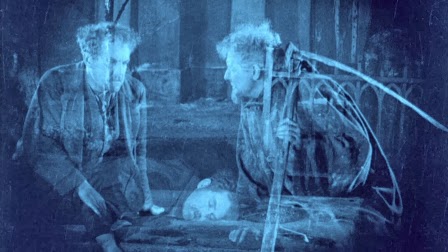
The Phantom Carriage (Victor Sjostrom, 1921)

A early Swedish experimental film playing with film form and the possibility cinema has of accessing different worlds and showing them on screen. A good example to discuss the status of cinema as the Seventh Art, which at the time was still very much debated. The film has a very slow pace, seemingly simulating the lasting of real time and trying to transport it to cinema. The story is loosely based on a Swedish legend similar to A Christmas Carol. The great thing is that you can find it in its entirety on Youtube (I mentioned it last year in a blog post about The Shining and some of its inspirations: http://artbookscinema.blogspot.co.uk/2013/04/seven-months-of-bfi-southbank.html


From the module French New Wave


Et Dieu...créa la femme/And God Created Woman (Roger Vadim, 1956)

If you are interested in stardom, and in female figures especially, this is the film for you. Brigitte Bardot's big debut with the film that changed her star persona both off and on screen. Moreover, the film, with its controversial topics and attitude, opened a debate on the French youth of the Fifties, its problems, indecision, but also its hunger for life. Delightful performance by what would then become the great Jean Louis Trintignant. A controversial picture which would have a big impact on the birth of the New Wave (pay attention to the use of Bardot's body in the opening sequence especially, and spot this shots in a famous Godard's film, Le Mepris/Contempt, to see the use he makes of the female body).

From the module Topics in World Cinema


The Battle of Algiers (Gillo Pontecorvo, 1966)

This week was the time of Gillo Pontecorvo's Golden Lion winning. This film is a stunning example of cinematography accompanied by Ennio Morricone's soundtrack and the use of non-professional actors in the roles of the Algerians. My favourite sequence in the whole film constructs a parallel montage of three different spaces as three Algerian women take bombs to different public spaces in the European part of the city. The sequence is beautifully constructed to build suspense, as we know about the bombs, and the camera focuses on the women's performances and the clock slowly approaches the explosions' time. You can watch it here to get an idea of the movie, but I would totally suggest it: 
Interesting in form and content as one of the richest documents about the Algerian war from the point of view of the colonized. Very interesting in this merit is the analysis of character identification developed by Murray Smith in the essay "The Battle of Algiers: Colonial Struggle and Collective Allegiance."

From the module Cinema and Spectatorship


Blonde Venus (Josef von Sternberg, 1932)

One of Sternberg's most famous and controversial pictures starring Marlene Dietrich, this film focuses on the performativity of gender (regarding femininity especially) as it portrays all the different roles Dietrich as woman performs. The narrative is not Sternberg's main focus as Laura Mulvey analyses he focuses on the impact of images and on the visual construction of the film, and his use of Dietrich's body deconstruction is a perfect example of psychoanalytic fetishization of the female body. So, have fun analyzing the different readings this film proposes, and Cary Grant is also in the film, but, who cares? Dietrich is The Star.

Friday, 17 January 2014

Suggested Viewings from KCL Film Studies

From the module Film Theory I


Sherlock Jr. (Buster Keaton, 1924)

Silent cinema has the power to communicate through the pure image, the essence of cinema, and Buster Keaton's film is a awesome early example of reflecting on the medium itself and on its capacity of triggering our emotions, and, possibly, changing our lives.

From the module French New Wave


Forbidden Games (René Clément, 1952)

A pre-Nouvelle Vague cinematic text set during 1940s Nazi bombings of France guiding us through the eyes of a spectacular child protagonist, the little Paulette, and her countryside friend, Michel. A human document on childhood's friendship, but also a critique of French society and religion.

From the module Topics in World Cinema


 Pather Panchali (Satyajit Ray,1955)

This was my favourite film among this week's, not only did it make me discover the amazing cinema of Ray, but it also is a human document of the finest kind opening Ray's Apu's Trilogy and always focusing on the child's gaze as bearer of the amazement and the surprise in front of the things of daily life. 

From the module Cinema and Spectatorship


 Peeping Tom (Michael Powell, 1960)

I finally had the chance to watch this Powell's gem, the cinematography and camerawork are perfect, and the story makes you question your role as spectator through the discourses on voyeurism and scopophilia. A cinematic thriller interrogating the very essence of the apparatus.

Monday, 16 December 2013

Suggested Viewings from KCL Film Studies

After the last stressful weeks I am finally back in Italy and have some time to catch up with the posts!
Here are the viewings of the past three weeks of uni!

From the module British National Cinema


My Beautiful Laundrette (Stephen Frears, 1985)

Set in Thatcherite Britain the first film to openly talk about homosexuality and the second generation immigrants generational conflict within their families and the British society itself. A very interesting case of film made for television which became huge on the big screen on its release.


Notting Hill (Roger Michell, 1999)

Well, what more can be said about this film? I watched it for ten times, I think, but I still laugh and enjoy it every single time! Don't care if it's all romance and clichès, we just need them sometimes. Think about the relationship between American and English characters, the representation of London and Britishness, the reflection on film stardom and the different personas Julia Roberts embodies, not only as Anna, but also as herself as star. 


In The Loop (Armando Iannucci, 2009)

Do you want a swearing lecture?? Please enjoy the best political satire film I've ever seen. Parody of the New Labour Government in the period of declaration of war to Iraq. The film works because it takes the piss out of the highest ranks in both British and American politics and dismantles their authorities, revealing the too-recurrent incapacity of our politicians. 
Here you can watch Malcolm Tucker at his best:


From the module Hollywood Cinema


Guess Who's Coming to Dinner (Stanley Kramer, 1967)

Starring the biggest black star of its time, Sydney Poitier, this film is a comedy of misunderstandings and racial stereotypes facing the human rights movements of the 60s. Katharine Hepburn and Spencer Tracy give amazing performances re-affirming themselves as two of the best actors of their generation. A film that makes  us still think today, if we consider that racism in both life and films has not disappeared at all, and does not always lead to such a happy ending.

Rocky I (John G. Avildsen, 1976)

Rocky probably contains one of the best and less cheesy love stories in Hollywood cinema. We all want Rocky to win, we all want him to move upwards the social ladder, we all want him to live the American Dream, and live it with him. 

From the module Contemporary Spanish Cinema


La leyenda del tiempo (Isaki Lacuesta, 2006)

One of the best films I've ever seen, I'm glad I have discovered such an interesting director as Isaki Lacuesta about whom I will write a separate post because I think his films can be very much appreciated and should be more well known. A touching film, travelling to the roots of flamenco in the bay of San Fernando, telling two stories which merge in the same quest: finding one's own voice and origins. The title comes from Federico Garcia Lorca's poem, which Camaron de la Isla, the international flamenco star celebrated and remembered in this film, chose as title for his breakthrough album. I leave you with my favourite lines: 
"Y si el Sueno finge muros
en la llenura del Tiempo,
el Tiempo le hace creer
que nace en aquel momento."


La Comunidad (Alex de la Iglesia, 2000)

One name and one word: Carmen Maura and hylarious. Alex de la Iglesia was another great discovery of this semester and I can only tell you to watch the film and be amazed by the colours, the grotesque, the popular culture quotes such as Star Wars, the recuperation of the Spanish tradition of Esperpento and the use of Madrid and its inhabitants/types in our postmodern reality.


Blancanieves (Pablo Berger, 2012)

Ok I've got to tell you, I cried so many times during this film, it became my absolute favourite among this year's. I will write a separate post on it because there is so much to say. It's a fairy-tale of other times, again searching for the roots of Spanishness, and celebrating Spain's lost silent cinema era, hommaging Spanish cinema, culture, and cinema of all world at its best.

From the module Chinese Cinemas


Xiao Wu/ Pickpocket (Jia Zhangke, 1998)

This is not a film for everyone, especially for its linguistic difficulties since it openly deals with the multiplicity of dialects and languages among the different Chinese communities. But if you are interested in this topic, or you are Chinese students or speakers this might be a good film choice to reflect on language. Check out the director's work in general, which always deals with these issues. 


Cape no. 7 (Wei Te-Sheng, 2008)

A light alternative to Hollywood musicals, funny, catchy, and a good example of Taiwanese blockbuster, nonetheless it was nicknamed "The Chinese Titanic". I leave the connections between the two to you!


Finding Mr. Right (Xiao Lu Xue, 2013)

Building on the Hollywoodian stereotype of love proposed by Sleepless in Seattle, this film promotes it to then dismantle it and actually offer a more realistic picture of humans rather than heroes, and of common relationship rather than the fairy-tale kind of love. I suggest it as a weekend viewing, but also as a point of reflection on issues of transnationalism and Hollywood influences.

Sunday, 24 November 2013

Suggested Viewings for the Weekend - KCL Film Studies


From the module British National Cinema: The Young Ones (Sidney J. Furie, 1961). Well, if you know and love Cliff Richard and want to be transported in the youth culture of the swinging London this is the film for you. From here you can actually see where all the High School Musicals came from!


From the module Hollywood Cinema: Gladiator (Ridley Scott, 2000). I am a big fan of epic dramas, and Gladiator has always been one of my favourites. Watch out for the different representations of masculinity, while you stare at Russel Crowe's body. Freud is always a good start here.

From the module Contemporary Spanish Cinema: The Red Squirrel (Julio Medem, 1993). Freud is back again in this mental fairytale suspended between dream and reality, exploring the boundaries of what being men and being women means and playing with our attention through symbolism and the actors' great performances until the end.

From the module Chinese Cinemas: The Wedding Banquet (Ang Lee, 1993). Again a film that works on many different levels: it can be an enjoyable family drama with a good amount of comedy, it can be a manifesto for the Asian gay community, it can be a challenge, but it can also be tradition, and make you explore the life of a Confucian family through five great characters. It's up to you to choose which of the possible readings it represents.


Monday, 18 November 2013

Suggested Viewings from KCL Film Studies

Unfortunately I didn't have time to post this during the weekend since I was finishing two essays, but last week was amazing in terms of topics and films. It was probably one of the few in which I was fully satisfied with everything we discussed.


From the module British National Cinema: Mandy (Alexander Mackendrick, 1952). A social drama in the light of post-war England, the touching story of a deaf six-year old girl and her family, building a bridge between different generations, and opening the door on the future.


From the module Hollywood Cinema: Fatal Attraction (Adrian Lyne, 1987). First of all, I love Glenn Close, but studying this film is much different than just watching it. I invite you to watch it and pay attention to how the female characters are portrayed in relation to post-feminism. You also may want to consider Newsweek's cover in 1986
So, please, don't be among the ones screaming "Kill the bitch", but consider the film's context first! 


From the module Contemporary Spanish Cinema: Te doy mis ojos/Take my eyes (Icíar Bollaín, 2003). An astonishing masterpiece, I was very pleased to discover the work of Icíar Bollaín. This film is so rich, and offers a very insightful approach to the subject of domestic violence. Among the actors you will recognize some familiar faces from All About My Mother (1999, Almodovar).  Pay attention to the use of paintings within the narrative and how art strenghtens the meaning of the film. 

From the module Chinese Cinemas: Infernal Affairs (Andrew Lau and Alan Mak, 2002). Who said Chinese films are slow and boring? Forget about The Departed, this is the original version. Masculinity is such an interesting topic to discover in relation to China's tradition, so enjoy this breathtaking film

Saturday, 2 November 2013

Suggested Viewings for the Weekend - KCL Film Studies

From the module British National Cinema: The Red Shoes (Powell and Pressburger, 1948). If you love ballet and fairytale prepare yourself to be enchanted in this tale of life and art becoming one.


From the module Hollywood Cinema: The Dark Knight (Christopher Nolan, 2008). One of the most successful franchises of our time, and, nevertheless, Heath Ledger's last appearance and awesome performance as The Joker.


From the module Contemporary Spanish Cinema: Pan's Labyrinth (Guillermo del Toro, 2006). The magic, the history, del Toro's beautiful camera work and aesthetic guides the viewers through an emotional, complex and rich expericence, enjoyable on many different levels.

From the module Chinese Cinemas: Two Stage Sisters (Jin Xie, 1964). An example of Maoist socialist cinema focusing on women, a consideration of female friendship and women power, and perfect for Chinese opera lovers.


Friday, 25 October 2013

Suggested Viewings for the Weekend - KCL Film Studies

From the module British National Cinema: Millions Like Us (Frank Launder and Sidney Gilliat, 1943). A war-time propaganda picture focusing on the role of women during WWII, interesting in terms of message, character representation, and sense of community.

From the module Hollywood Cinema: Beverly Hills Cop (Martin Brest, 1984). Biggest grossing film in 1984, Eddie Murphy's laugh (can be both hilarious and annoying), a film embodying the structure of the high concept in the blockbuster era.


From the module Contemporary Spanish Cinema: Vicky, Cristina, Barcelona (Woody Allen, 2008). A film that works on many levels: simple pleasurable experience about the turistic Barcelona, a transnational and "fake" representation of Spanishness, a starting point for stardom studies, plus Javier Bardem is always a visual pleasure.

From the module Chinese Cinemas: The Goddess (Yonggang Wu, 1934) Probably the most modern and interesting silent film I have ever seen, emotional, starring the "Chinese Garbo" Ruan Lingyu, a tragic movie star figure in the 30s.


Sunday, 20 October 2013

Suggested Viewings for the Weekend KCL Film Studies


From the module British National Cinema: Say it with Flowers (1934) directed by John Baxter. A British quota-quickie famous among local audiences because of its use of the beloved music hall tradition and one of its biggest star's performance: Marie Kendal.


From the module Hollywood Cinema: Butch Cassidy and the Sundance Kid (1969) directed by George Roy Hill. Paul Newman and Robert Redford in a revisitation of the Western genre becoming a manifesto of the Hollywood Renaissance? Definitely one my favourite films among this week's. And watch out for references to the French New Wave!


From the module Contemporary Spanish Cinema: Tesis (1996) directed by Alejandro Amenabar. One of the best firsts features ever. The film is an intense study on spectatorship starring the already star Ana Torrent and the soon to be stars Fele Martinez and Eduardo Noriega in a breathtaking thriller questioning the desires of our gaze.


From the module Chinese Cinemas: Rouge (1988) directed by Stanley Kwan. What happens when the ghost of a 1930s brothel's prostitute walks into the present to find her lost lover? And what happened to the Hong-Kong she left, where everything was red and gold, and love was one and only forever? This film has already found its place among my favourites.


Friday, 11 October 2013

Some suggested viewings from KCL Film Studies Course

Since I watched 6 films during the past 5 days, I thought I could share the films' titles weekly as suggested viewings for you!

From the module British National Cinema: Evergreen (1934) by Victor Savillestarring the star Jessie Matthews, great if you love musical, London, theatre life and art deco.


From the module Hollywood Cinema: Casablanca (1942) by Michael Curtiz, always classy, never goes out of fashion, personally I am never tired of watching it, "Here's looking at you kid."


Disorder by Huang Weikai, of which you can read more in my previous post:


From the module Contemporary Spanish Cinema: Raise Ravens (1976) by Carlos Saura. Beautiful, I would say, fascinating, symbolic, starring two wonderful actresses such as Ana Torrent and Geraldine Chaplin.


From the Film Society weekly screening: Masculin Feminin (1966) by Jean Luc Godard. Starring the grown-up Jean Pierre Leaud, a wonderful reflection on French youth in the 60s, a reflection on genders, and just as good as only Godard could have made it.


From the module Chinese Cinemas: A City of Sadness (1989) by Hou Hsiao-hsien. Difficult to follow, I have to admit, slow and long, but once you start feeling part of the narrative it is an amazing journey in the depth of Chinese unspoken history and non-speaking people.